
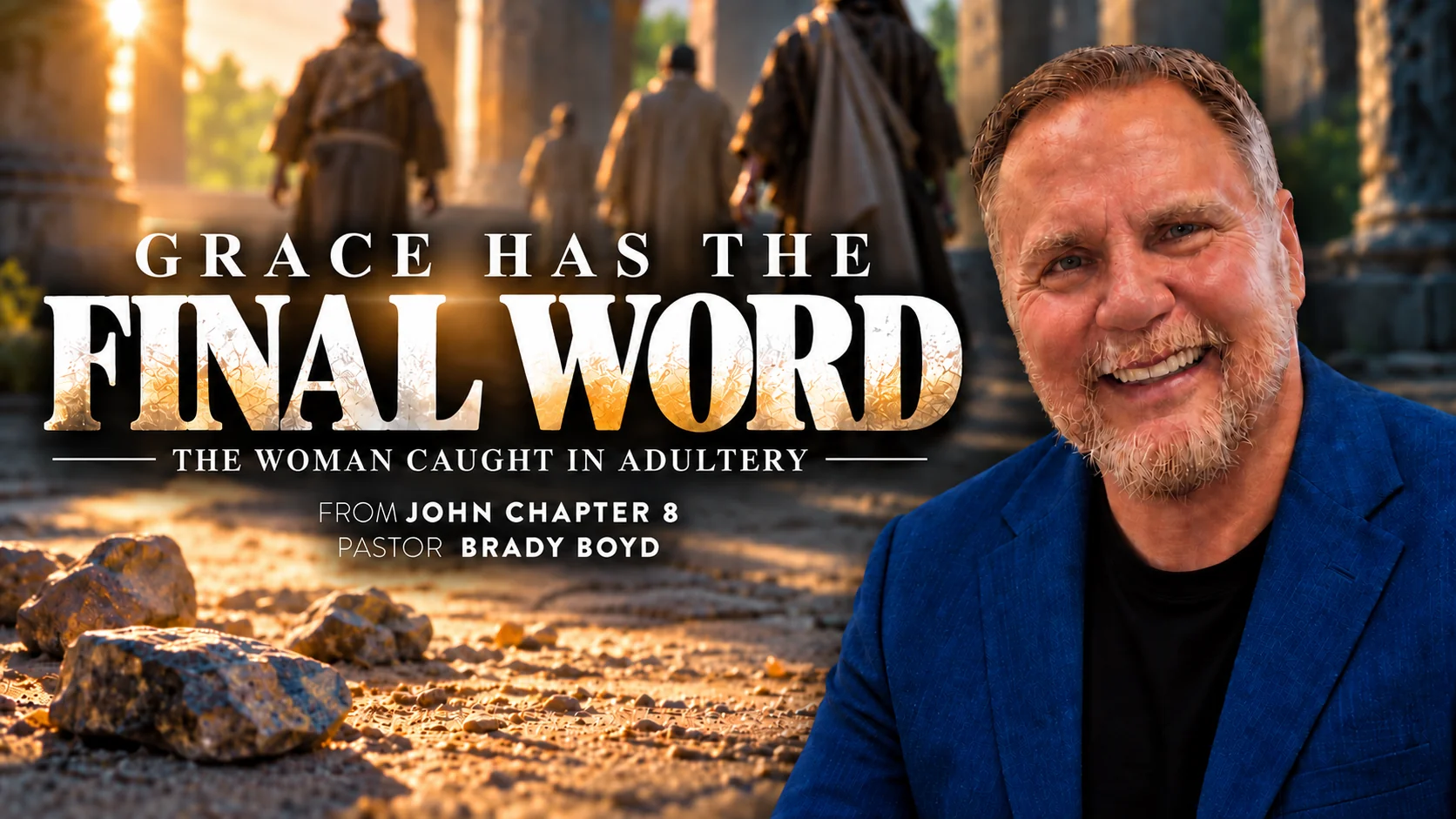
Grace Has the Final Word
Chapters
Key Takeaways
- •Jesus sat among the people. He confronted, challenged, and forgave sinners, but not once in the gospels did he shame one.
- •Shame changes behavior but it also changes a person's humanity. It convinces them there is no hope of changing, and it takes away the courage to ask for help.
- •Condemnation is a final sentence. Romans 8:1 says there is now no condemnation for those who are in Christ Jesus.
- •The woman was guilty, but she was not condemned. The gospel comes to guilty people and gives them hope.
- •A parolee is set free for good behavior but the record follows him. A pardoned person is absolved as if never convicted. In Christ you are pardoned, not paroled.
- •Pardoned people forgive. If you have been forgiven that much, you can give grace away.
At dawn Jesus came into the temple courts, and the people gathered around him, and he sat down to teach them. Pastor Brady stops on that detail before anything else happens in the story. Jesus did not lord over the crowd or hover above it. He sat in the middle of the people. That is where he is when the teachers of the law and the Pharisees push a woman into the center of the group and announce that she was caught in the act of adultery.
The first thing Brady notices is who is missing. It takes two people to commit this sin, and the law of Moses said to stone both of them. Only the woman is brought in. The men who dragged her there are being very selective about which parts of the law they quote and which people they punish. Brady's guess is that the man was somewhere in the crowd, or hiding. Either way, a woman is made to stand alone in front of a group of men, and the whole scene is designed as a trap for Jesus. If he says stone her, he is cruel. If he says let her go, he has broken the law.
What Jesus never did
Brady has watched this same spirit work inside churches for thirty years, and he has been on the receiving end of it. Religious people begin nitpicking. Minor things get turned into major accusations. They are not looking for grace. They are looking for someone to condemn.
Jesus bends down and writes in the dirt. Nobody knows what he wrote, and Brady is not going to pretend otherwise. What matters is what he said when he straightened up: if any one of you is without sin, throw the first stone. Then he bends down again, and the crowd starts leaving one at a time, the older ones first. Brady's take on that: the old men had more sin to remember. They had a longer rearview mirror, and in it they could see how many times they had deserved judgment and received grace instead.
"You cannot find a single instance in the gospels where Jesus looked at a sinner and shamed them. He confronted them. He talked to them. He challenged them. He loved them. He forgave them. He restored them. Not one time did he ever shame them."
Being made to stand before a group is a shaming mechanism, and we still use it. Someone disagrees with you, so you bring their failure into your group chat or your Facebook circle and invite everyone to shun them. Brady's counsel to young parents lands here: never tell your child, your spouse, your friend, or anyone else that they should be ashamed of themselves. He and Pam never said it to their kids, and they do not say it to each other. Shame will change behavior, but it convinces a person there is no hope of ever getting better. It changes their humanity, not just their conduct.
He points to the people he has known who struggle with addiction. What they need is not shame but courage, the courage to raise a hand and say, "I need help." That step only comes once a person believes change is possible. Shame tells them the opposite: there is no use trying, I will always be this way. Speak that over someone and you are speaking a curse only the Holy Spirit can break.
Guilty, but not condemned
When the accusers are gone, Jesus asks the woman where they went and whether anyone has condemned her. No one has. Then he says the words Brady reads as the word of the Lord over the whole room.
"Then neither do I condemn you," Jesus declared. "Go now and leave your life of sin."
From there he turns to Romans 8:1. There is now no condemnation for those who are in Christ Jesus. Brady wants that read carefully. Not Jesus as your mascot or your life coach or a good guy you admire, but Jesus as King, seated on the throne of your life. When that is settled, the enemy can accuse all day long and it bounces off. If it is not settled yet, the Village Church is a safe place to wrestle with it, to ask questions, to bring past church hurt.
Condemnation is a final sentence. When you condemn someone, you have appointed yourself their judge and declared them guilty for good, often from a distance, about a person you have never had a conversation with. Brady calls that one of the central purposes of demonic spirits: to stamp a final sentence on a life. The gospel turns it upside down.
"She was guilty, but she was not condemned. All of us in the room are guilty of something, but we're not condemned."
Paroled or pardoned
Brady tells a story he has told before and thinks he should tell every few weeks. A large man, a former college basketball player, worshiping a few rows in front of him, comes up afterward and takes him to lunch. At eighteen, the summer before college, he got in a car with guys he did not know to buy beer across the state line. In the liquor store parking lot one of them put a gun in his hand. The owner drew a weapon, and the young man fired and killed him. He had never been arrested before. He went to prison for twenty years.
While he was inside, the governor ate a meal he had cooked, liked it, and made him his personal cook. For eight years he rode a van from his cell to the governor's mansion and back every day. At the end of that term the governor signed his pardon and slid it across the table to him.
Brady asked him whether he meant parole. He did not. A parolee is released for good behavior, but the record never changes. It follows him, and one mistake sends him back. A pardoned man is still guilty of what he did, and he will carry that the rest of his life, but he is absolved of the conviction as if it never happened. There is no record.
"You're guilty, but you haven't been paroled. And some of you are living your life like a parolee."
Brady's name for that way of living is Jesus jail. Good day, I am out. Bad day, I am back in. In and out all week. It is an awful way to live, and it misreads what happened when you came to Christ. Your past has consequences, the same way that man's does. But there is no record of your wrong. It has been written off.
Where the battle is
Romans 8:5 says those who live according to the flesh set their minds on what the flesh desires, and those who live according to the Spirit set their minds on what the Spirit desires. The real battle is not out there. It is in the mind. Brady woke up Sunday morning and prayed, "Come, Holy Spirit," because he knows the battle is real and he was deciding how it would be fought that day.
The choice shows up in how you treat people. If you are living like a parolee, you treat everyone else like a parolee, pointing out their guilt for a cheap hit of feeling better than them. If you know you are pardoned, you start forgiving.
"If you've been forgiven that much, how in the world can you not forgive the people around you? When you're swimming in oceans of grace, you can't pour a cup of water on somebody else?"
Receive what has already been signed
The pardon was signed and slid across the table. All that man had to do was take it. He did not have to go do good works first or behave for six months. Brady says salvation works the same way. You do not have to behave for Jesus to like you. You have to believe. The hard work is already done. Jesus has already forgiven you. Receive it.
He led the room in a prayer for anyone ready to say yes, then gave one more instruction to everyone who has been beating themselves up: go be kind to yourself today. You messed up. You have been pardoned, though. Say nice things about yourself and believe them.
The Village Church gathers at the Colorado Springs Marriott on September 27 and October 4, then returns to Phil Long Music Hall for the rest of the year. Wherever the building is, the church is where we gather.
Get Updates
Subscribe to receive new messages and ministry updates.
Related Articles

Hidden Heroes: Cimarron Hills Food Pantry
In Cimarron Hills, Pastor Scott Maxon and Colorado Freedom Church make sure no neighbor goes hungry - one Sunday, one family at a time.
Hidden Heroes: Good Morgans
In the Arkansas River Valley, Good Morgans keeps people moving - so a broken-down car never means a lost job or a missed appointment.